
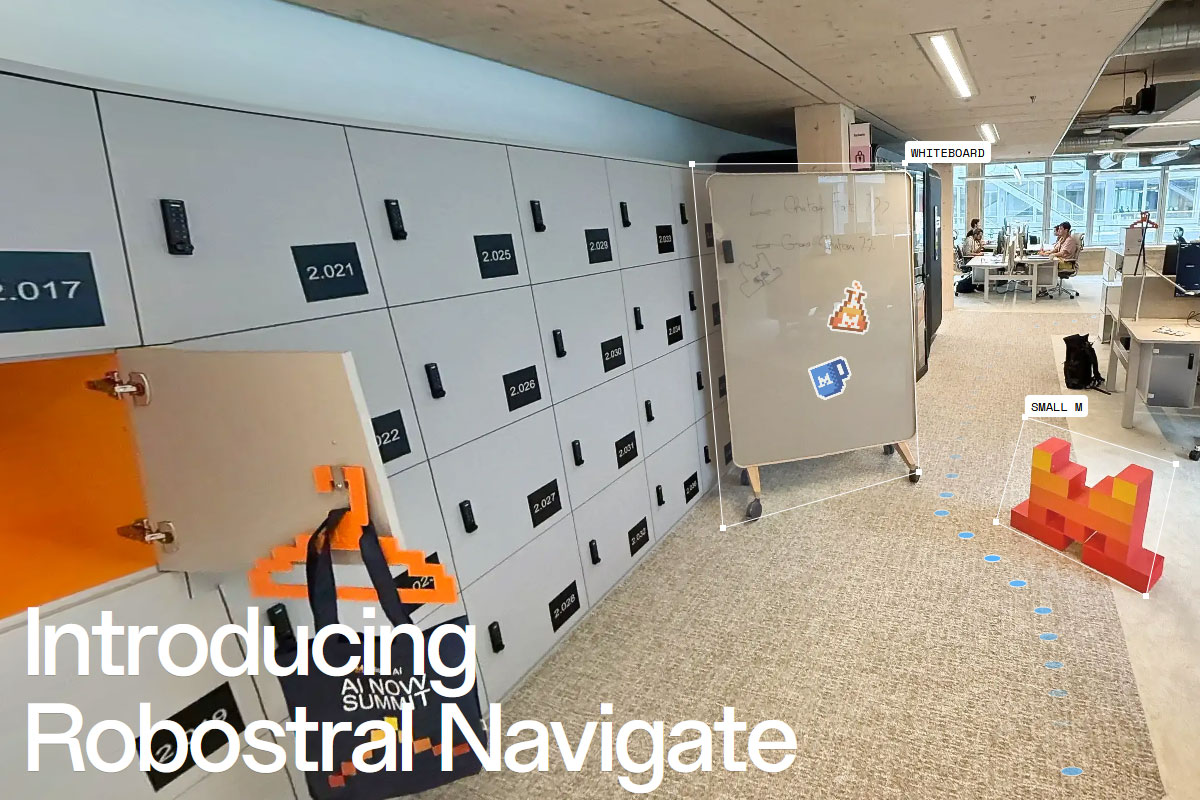
A new AI model called Robostral Navigate can guide robots through real-world environments using just one standard camera, no depth sensors, and no LiDAR.
The model was released by Robostral and is built on an 8 billion parameter architecture. It takes a plain-language instruction and a live camera feed, then moves a robot through a space on its own.
How It Performs
Robostral Navigate scored 76.6% on the R2R-CE unseen validation benchmark, the standard test for robots navigating environments they were never trained on.
That result beats the best single-camera approach by 9.7 percentage points. It also outperforms systems that use depth sensors or multiple cameras by 4.5 points.
On seen environments, the model scored 79.4%. The company says performance is still improving and has not plateaued.
How It Was Built
The model was built entirely in-house and does not use existing open-source vision-language models. It started from Robostral's own grounding model, which understands pointing, counting, and object localization.
Training used a simulation pipeline that generated around 400,000 trajectories across 6,000 virtual scenes. A token-efficient method called prefix-caching reduced training time dramatically, turning what would have been months of computation into days.
After supervised training, the team applied a reinforcement learning algorithm called CISPO. This allowed the model to learn from failures and improve through trial and error, adding 3.2% to its success rate.
Navigation Approach
The model navigates using a pointing method. It looks at the current camera view and predicts where the robot should move next, including the desired orientation on arrival.
When the target is outside the camera's field of view, the model switches to local displacement commands, such as moving a set distance forward or turning a specific number of degrees.
This approach makes the model adaptable to different camera types and robot sizes without needing recalibration.
Real-World Uses
Robostral says the model works across offices, homes, commercial buildings, and outdoor spaces. It runs on wheeled, legged, and flying robots.
Target industries include manufacturing, delivery, logistics, and hospitality. The company says navigation is one of the most in-demand capabilities from its current customers.
The company says Robostral Navigate is the first step toward a broader embodied AI agent. It is actively hiring research scientists and engineers to expand its robotics team.