
Meta has launched Muse Spark 1.1, an updated AI model built for coding and agentic work, as it pushes to compete with OpenAI and Anthropic.
The model was introduced on Thursday by Meta's AI chief Alexandr Wang, who leads Meta Superintelligence Labs. It follows the original Muse Spark, released in April, which was only available to select partners.
What Muse Spark 1.1 Can Do
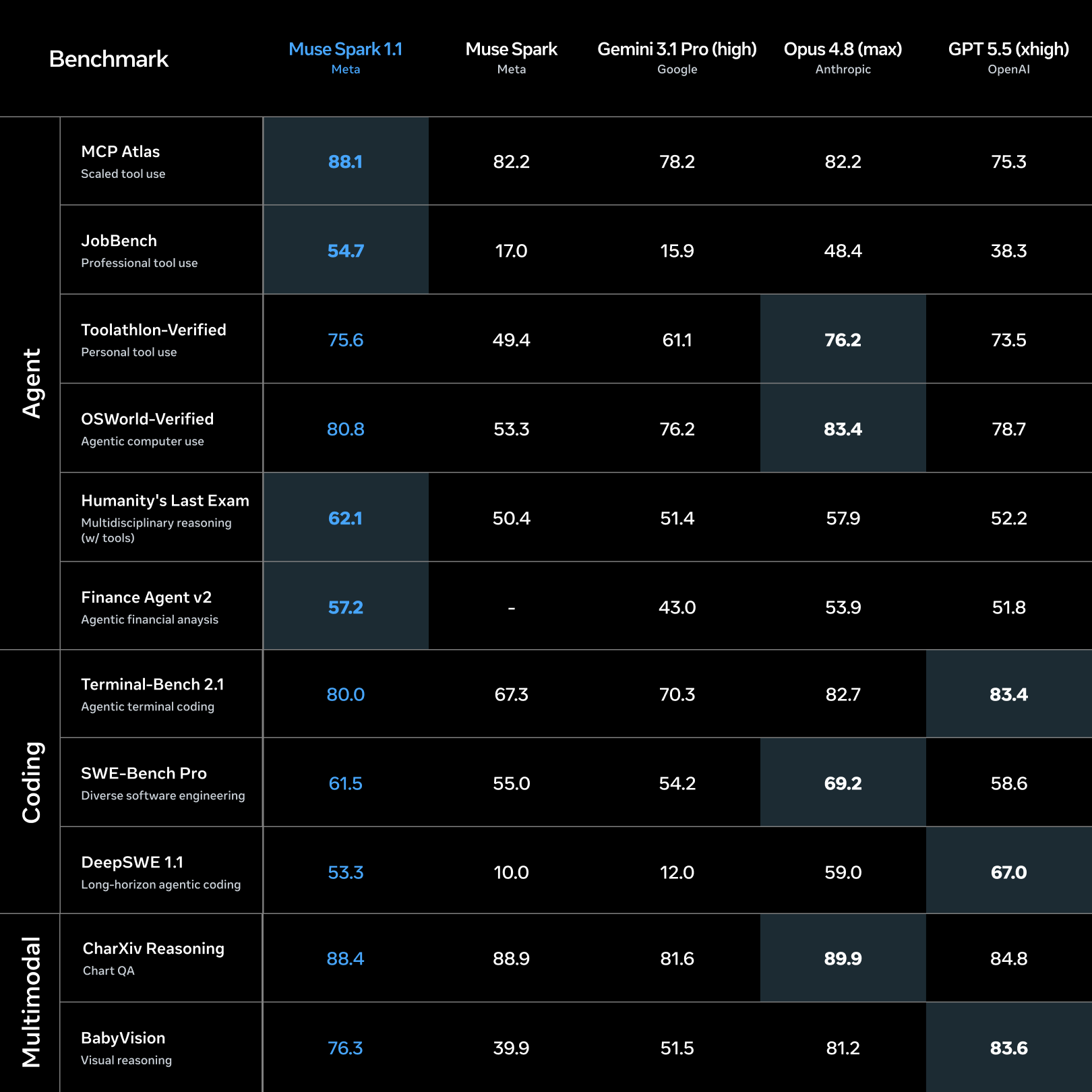
Muse Spark 1.1 is designed to handle complex coding tasks. It can diagnose and fix bugs, implement new features in large codebases, and run code migrations.
The model also supports multimodal tasks. It can process images, video, and audio, and take actions on behalf of users, such as creating a Facebook Marketplace listing from a smartphone video.
Wang said Meta trained the model to work with popular agentic coding tools and harnesses that developers already use. This includes support for planning mode, subagent delegation, and context compaction.
Early partners have praised the model. Replit CEO Amjad Masad called it "a complete agentic foundation," citing its million-token context window and multimodal support.
Pricing and Availability
Meta is making the API available through a public preview developer portal. New users can join a waitlist for access.
Pricing is set at $1.25 per million input tokens and $4.25 per million output tokens. Every new account gets $20 in free credits to start.
Wang described the pricing as competitive against Anthropic and OpenAI. Meta is currently limiting API access to its own properties and is not yet listing on third-party platforms like OpenRouter.
CEO Mark Zuckerberg is under pressure from Wall Street to show returns on Meta's growing AI spend. Unlike rivals, Meta does not have a cloud business, though it has said it plans to build one.
This marks a shift in Meta's strategy. The company previously focused on releasing open-source models under the Llama name. It is now selling access to proprietary models.
Wang said a future open-source version of Muse Spark is in development but gave no release date.
Also this week, Meta released Muse Image, a model for generating images aimed at creators and advertisers.
Meta also confirmed it is training a more powerful model, code-named Watermelon. No release date was given.
Wang added that he has personally been using the model to help with health research, including reading academic papers and accessing personal health data.