
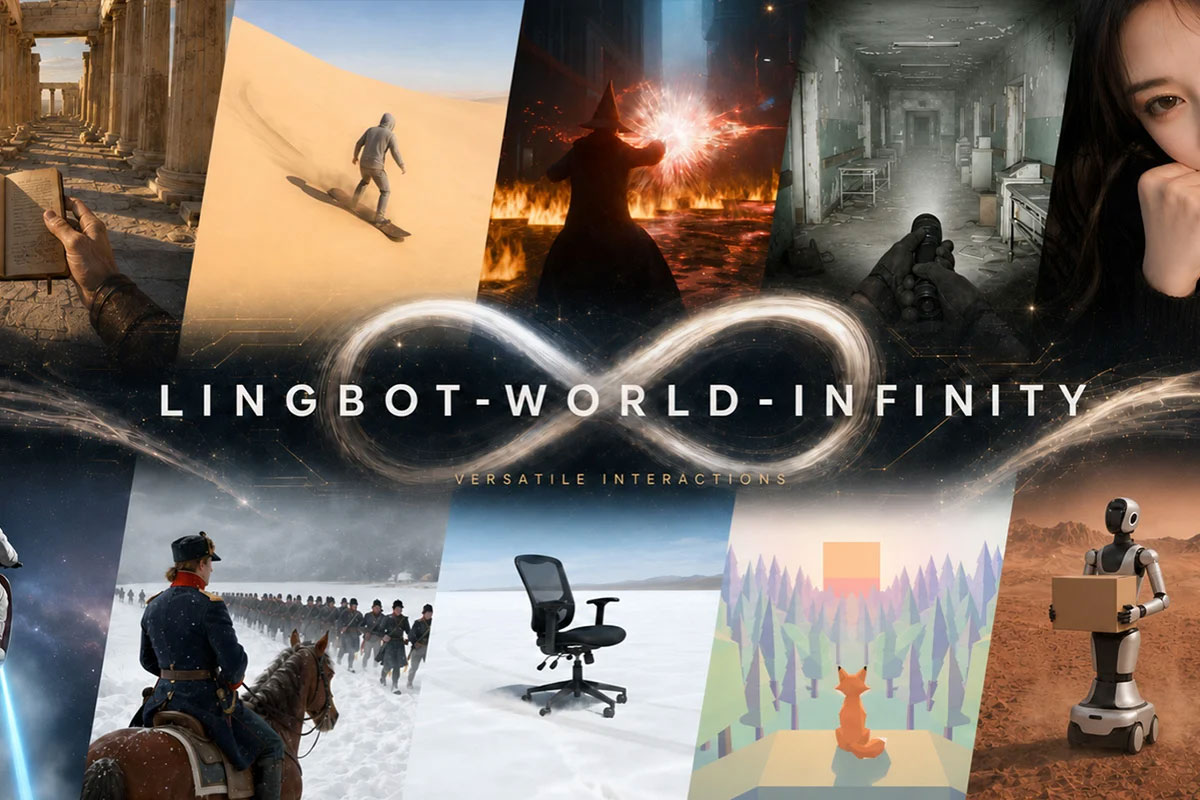
Robbyant, an embodied AI company within Ant Group, released LingBot-World 2.0 on July 9, 2026. The model is open source and supports AI world generation that runs continuously for a full hour.
The first version of LingBot-World could generate stable scenes for only a few minutes. Version 2.0 extends that to 60 minutes of uninterrupted output.
The model runs at 720p resolution and 60 frames per second. It holds that quality level throughout the full session without degradation.
Robbyant says the model uses a Causal Pretraining Paradigm combined with a proprietary MoBA — short for Mask of Bidirectional Attention — mechanism. This approach teaches the model to learn how environments evolve over time in strict chronological order.
Earlier AI world models often broke down over long runs, showing texture blurring, geometry collapse, and scene instability. Robbyant says the MoBA mechanism removes those compounding errors.
The company ran hour-long stress tests before the release. The model held visual fidelity with zero quality drift throughout.
The company says visual consistency is maintained even during fast-moving, action-heavy sequences. According to Robbyant, maintaining quality during these moments was a key challenge that earlier world models could not reliably solve.
Robbyant also built a fast inference version of the model alongside the open-source pre-trained release. The generation pipeline was rebuilt to deliver a low-latency, gaming-like experience for users.
How LingBot-World 2.0 Works
LingBot-World 2.0 supports a wide range of character actions inside generated worlds. Users can attack, shoot arrows, cast spells, jump, and glide.
Text commands can trigger global events such as day-night cycles, weather changes, and new characters entering a scene. Outcomes are generated in real time based on the current scene state.
The model features a built-in dual-agent system. A Pilot Agent handles character behavior and execution, while a Director Agent introduces new events as the scene develops.
Multiple users can join a single persistent AI-generated world at the same time. This enables collaborative exploration and interaction within one shared environment.
Robbyant describes this as moving world models from "watchable and controllable" to "sustainably interactive and dynamically evolving." The company says this is a first in the world model sector.
Where to Access It
The model is live on the Reactor platform at reactor.inc/lingbot-world-v2. Users can start interacting without waiting for a full video sequence to generate.
Content is generated, transmitted, and displayed at the same time. This keeps latency low and lets users control characters with a keyboard in real time.
The model is also on GitHub and Hugging Face with day-0 support for SGLang. The open-source license lets developers freely use, modify, and build on the code for their own projects.
On the same day, Robbyant also open-sourced LingBot-Video. The company says it is the first open-source video generation model built on a Mixture-of-Experts architecture designed for embodied intelligence.
LingBot-Video was designed for robotics applications. It targets improvements in inference efficiency, physical plausibility, action comprehension, and task completion.
The aim is to move video models from digital content creation into real-world robotic systems. Both LingBot-World 2.0 and LingBot-Video went live on July 9, 2026.
Five More Models Round Out a Full Robotics Stack
LingBot-World 2.0 and LingBot-Video were part of a broader release week in which Robbyant launched six models total, forming what it calls a complete embodied-native full-stack for robotics.
LingBot-Depth 2.0 is a spatial perception model trained on 150 million samples. It tops the rankings in 12 out of 16 depth completion benchmarks and cuts depth error in half compared to its predecessor, dropping RMSE from 0.132 to 0.062.
The model handles surfaces that typically trip up standard depth cameras, including mirrors, glass, and transparent objects. Orbbec, a robotics vision hardware company, has certified it for commercial use and plans to ship an SDK and integrated camera with the model built in by end of 2026.
LingBot-Vision is the visual foundation model powering LingBot-Depth 2.0. It is the first model in the industry to use boundary structure as a pre-training objective, trained on 160 million images.
LingBot-VLA 2.0 is a vision-language-action model pre-trained on 60,000 hours of real-world robot interaction data from 20 robot types across 17 manufacturers. It covers single-arm, dual-arm, bipedal, and wheeled configurations.
On Shanghai Jiao Tong University's GM-100 benchmark, it outperformed competing models including π0.5 and GR00T N1.7 in dual-arm manipulation tasks. Deployment runs in under 130 milliseconds on an RTX 4090.
Commercial pilots are already underway with GuoDa Drugstore and Longsheng Technology in retail sorting and industrial automation.
LingBot-VA 2.0 is the sixth model and the final piece of the stack. Robbyant calls it the industry's first embodied-native video-action world model, built from scratch for physical world control rather than adapted from digital video tools.
It runs at 150Hz on a single GPU and can learn new tasks from as few as 20 demonstrations without retraining.
Robbyant CEO Zhu Xing said the company will continue exploring new limits in embodied intelligence while building an open ecosystem to speed up robot deployment in industrial and real-world settings.
All six models are available on GitHub and Hugging Face under open-source licenses.